


The Case Did Not Fit the Workflow. Antoine Pinaud Changed the Question!

A Community Voices story about frustration, freedom, and the moment digital design became a way of thinking

The most important moment in a digital dentistry journey is not always the first successful design. Sometimes it is the moment a professional becomes dissatisfied with an answer that is technically acceptable but clinically incomplete.
That is where Antoine Pinaud’s story begins.
Based in Marseille, France, Antoine is a dental technician and digital designer with 35 years of experience. After working in dental prosthetics and spending almost nine years supporting and training digital dentistry users at Nobel Biocare, he became increasingly involved in guided surgery and 3D planning.
His story is not about discovering a magic button. It is about reaching the point where experience and technical understanding had outgrown a fixed workflow. It is a story for anyone who has understood the technical demands of a case and thought: I can see the appropriate design solution—but the workflow is asking me to do something else. The clinician remains responsible for the clinical decisions; Antoine’s role is to translate those decisions into a reliable and practical technical design.
— Dr. Samira Alrefaey, Blog Editor & Marketing Specialist, BlenderforDental
He Could See the Solution. He Couldn’t Build It.
A difficult case does not always announce itself as a disaster. Sometimes it arrives as a series of small compromises.
The anatomy creates one technical requirement. The surgical protocol introduces another constraint. The prosthetic project changes the priorities. The instrumentation limits what can be done. The software presents a predefined sequence and quietly asks the designer to adapt the technical solution to it. The clinician remains responsible for deciding what the case requires; Antoine’s role is to translate those clinical decisions into an appropriate design.
For Antoine, that was the point at which digital dentistry began to feel too narrow.
“One of the biggest challenges was finding enough flexibility in the digital workflow.”
For conventional cases, a standard workflow can be exactly what is needed. It creates order, reduces unnecessary decisions, and helps the work move forward. But when the case becomes more specific, the same structure can become a restriction.
Antoine had reached a point where he did not want the technical solution to be limited by whatever the software allowed. He wanted to understand the clinical requirements defined by the practitioner and build the appropriate design around them.
“Professionally, it was sometimes frustrating to know what I wanted to achieve technically but not always have the freedom to build the solution exactly as I imagined it.”
That sentence contains the struggle. He was not lost. He was not starting from zero. He had the experience to recognise the right direction. The problem was that the workflow could not always follow him there.

The Problem Was Bigger Than One Piece of Software
Antoine’s frustration did not come from wanting more features for their own sake. It came from understanding that a surgical guide is only one part of a complete clinical and technical process.
After years in dental prosthetics, followed by nearly nine years in digital dentistry support and training, he had learned to look beyond the final design. Guided surgery required him to understand the entire workflow: the anatomy, the surgical protocol, the instrumentation, the prosthetic objective, and the practical conditions in which the result would be used.
The guide was not the beginning of the work. It was the consequence of many decisions made before it.
That distinction became increasingly important as Antoine developed his focus on guided-surgery planning and design. A guide could be perfectly modelled and still fail to answer the real needs of the case. A workflow could be efficient and still force too many compromises.
“The main limitation was the lack of freedom when a case moved outside a predefined workflow.”
This was the tension he needed to solve: how to keep the simplicity of a structured environment without losing the freedom required by a demanding case.
The Shift Was Not from Old Software to New Software
When Antoine started working inside BlenderforDental, the important change was not simply that he had found another platform. The deeper change was that he could approach the work from a different starting point.
Before, the workflow came first and the case had to fit inside it. Now, the case could come first.
“The biggest shift was moving from following a workflow to creating my own workflow.”
That sentence is the turning point of the story. It changes the designer’s role from operator to problem-solver.
Instead of beginning with a list of available steps, Antoine could begin with the practitioner’s clinical requirements, analyze the technical constraints, and decide how to construct the appropriate design solution. Instead of asking which template or fixed process could handle the case, he could ask what the case actually needed.
“BlenderforDental gave me the freedom to think first and design second. The software became a tool supporting the reasoning instead of defining it.”
This is what freedom means in Antoine’s work. It does not mean adding complexity to every case. It means having the ability to introduce complexity only when the anatomy, the protocol, the instrumentation, or the prosthetic project requires it.

The Aha Moment: He Changed the Question
The clearest breakthrough in Antoine’s story came when he began receiving cases that did not fit a conventional guided-surgery workflow.
This was the moment when the old question stopped being useful.
The old question was: Which software workflow can handle this case?
The new question was:
“What solution does this need, and how can I build it?”
That is the aha moment—not because the case suddenly became easy, but because its difficulty was no longer being defined by the limits of the software.
Antoine realised that he had reached another level when he stopped treating an unusual case as a reason to search for the correct predefined pathway. He could analyse the situation, identify the constraints, combine different approaches, and create a solution that made sense for that case.
The change was subtle from the outside. There was no dramatic announcement. But internally, it changed the entire relationship between professional judgement and digital tools.
“The complexity of the case was no longer defined by the limitations of the software.”
That is the moment Antoine levelled up: not when he memorised another sequence, but when he became confident enough to design beyond one.
The Tools Mattered Because They Opened the Workflow
For Antoine, the greatest impact came from combining the guided-surgery workflow with direct access to Blender’s modelling tools.
The value was not one isolated feature. It was the ability to modify geometry freely, create custom components, combine different approaches, and move outside a predefined design process when the case required it.
“For me, the real strength is not one individual tool, but the combination of dental-specific tools with the freedom of Blender.”
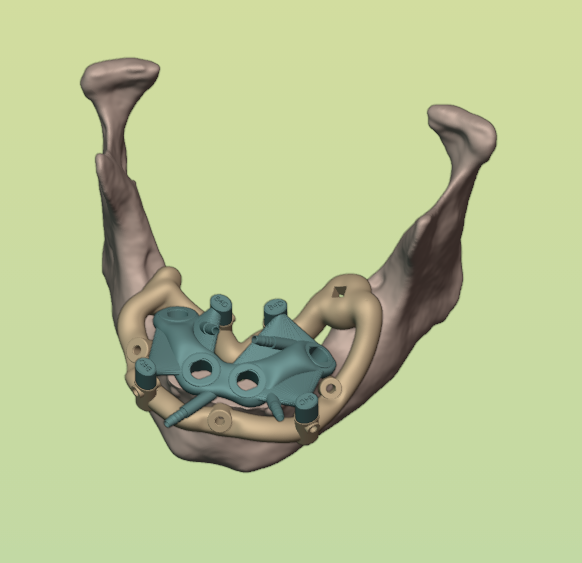
The case images from Antoine’s work show this idea from several angles: 3D planning around anatomical structures, custom guide design on a mandibular model, guidance openings and fixation elements, and a final guide positioned intraorally.
Together, they tell a more accurate story than a list of software features could. The work moves through several stages, but the thinking remains continuous: understand the situation, anticipate the constraints, build the design, and check whether the final object can serve the intended clinical purpose.

His Philosophy Is Not “More Complexity”
It would be easy to misunderstand Antoine’s approach as a demand for unlimited customisation. That is not what he is saying.
His philosophy is more disciplined than that: find the simplest solution that fully answers the needs of the case.
“A conventional case should remain conventional when that is enough. Complexity should only be introduced when the anatomy, the surgical protocol, the instrumentation or the prosthetic project actually requires it.”
This principle is what prevents freedom from becoming noise. Antoine does not want to make a conventional case complicated to prove that he can. He wants the ability to make a demanding case specific when a standard workflow is no longer appropriate.
For him, good guided-surgery design begins with anticipation and an understanding of the complete workflow. The guide is the result of that reasoning, not the starting point. The practitioner remains responsible for the clinical decisions. The designer’s responsibility is to translate those decisions into a technically reliable and practical solution.


What Changed After the Breakthrough
Antoine did not become less careful after gaining more freedom. He became more deliberate.
Simple cases could remain simple. Difficult cases could be analyzed without being forced into an unsuitable sequence.
Technology could help him construct and refine the solution, but it would not decide what the solution should be. The professional remained responsible for understanding the case and making the important choices.
That is the practical difference between automation that replaces thinking and technology that supports it.
His Advice to New Designers
Antoine’s advice to someone starting in digital dentistry is not to begin by collecting more tools. It is to understand the reason behind the work.
“Learn to understand the ‘why’ before focusing on the ‘how’.”
Anatomy, surgical protocol, instrumentation, and case objectives should come before software technique. Otherwise, it is possible to become efficient at following steps without understanding whether those steps are appropriate.
He recommends starting simply, mastering the fundamentals, and introducing complexity only when it creates a real benefit.
“Most importantly, stay curious and keep experimenting.”
For Antoine, curiosity is not a personality trait separate from technical skill. It is part of the skill. It allows the designer to test assumptions, recognize when a workflow is no longer enough, and imagine a solution that was not available as a predefined option.
The limits of a tool are not always the limits of the work. Sometimes they are the limits of what the professional has learned to imagine.
The Story Antoine Wants to Continue
What Antoine values most about digital dentistry is that it never stays still. But evolution, in his view, is useful only when it gives professionals more freedom to think, anticipate, and communicate—not simply when it makes a process faster.
His understanding of guided surgery reflects that belief. The guide itself is only the final result. The real work takes place earlier, when the team understands the case, anticipates the constraints, discusses the options, and translates clinical decisions into a solution that can be used during surgery.
That is also why BlenderforDental matters to him. It offers a structured dental environment without removing the freedom to create when the case requires something outside the standard workflow.
Antoine’s story is not about software replacing experience. It is about giving experience a more flexible digital language.
Connect with Antoine Pinaud
Antoine shares his work and professional perspective through Pinaud Planification 3D:
•Facebook: Pinaud Planification 3D
•Instagram: pinaudplanification3d
•LinkedIn: Antoine Pinaud
Ready to Start Your Own Journey?
Antoine’s technical turning point began with a question: What design solution does this case require, and how can I build it?
For professionals who want to understand the process, retain control, and develop skill rather than depend on a black-box sequence, BlenderforDental offers a structured starting point with room to think beyond the standard workflow.
The best place to begin is not with unnecessary complexity. Begin with the fundamentals. Understand the case. Learn the tools. Add freedom as your understanding grows.
Explore the Blender for Dental shop and discover the B4D approach to human-led digital dentistry.
B4D’s continuing development—including controlled segmentation tools such as Airways—follows the same principle Antoine describes: technology can assist professional reasoning, but it should not take ownership of it.
Share Your Story
If your work in digital dentistry has changed because a standard workflow was no longer enough, we would like to hear from you. Tell us what challenged you, what changed your direction, and what you learned when the answer was not already built into the software.
Editor’s Credit
This article was edited and curated by Dr. Samira Alrefaey, Blog Editor & Marketing Specialist at BlenderforDental. Antoine’s story is a reminder that progress in digital dentistry is not only about learning faster tools. It is also about learning to ask better questions.
About BlenderforDental
BlenderforDental is a human-led digital dentistry platform designed to give clinicians, technicians, and digital designers greater control over their workflows. B4D combines dental-specific tools with the flexibility of Blender, helping professionals develop understanding and create solutions that respond to the case rather than forcing every case into the same template.


Comments