


The Quiet Conversation of Vertices: A Story of Perfect Alignment

Inside the One-to-Many ICP workflow, where complex math becomes a calm dialogue between two surfaces.
There is a specific kind of tension in digital dentistry that occurs right before a "snap." It’s that split second where you wonder if the math will hold, if the scan body will seat, and if the virtual world will actually match the physical one waiting in the lab.
In this session, we aren't looking at artistic wax-ups or smile designs. We are looking at the engine room of precision: ICP Alignment. To a stranger, it looks like a screen full of triangles and numbers. To a clinician, it is the difference between a restoration that drops into place and one that requires a stressful afternoon of adjustments.
What follows is the story of a five-minute workflow that feels like a quiet conversation. It’s about "parenting" objects, making "mental notes" of landmarks, and watching the software perform what our instructor calls "the magic bit."
— Dr. Samira Alrefaey
Blog Editor & Marketing Specialist | BlenderforDental
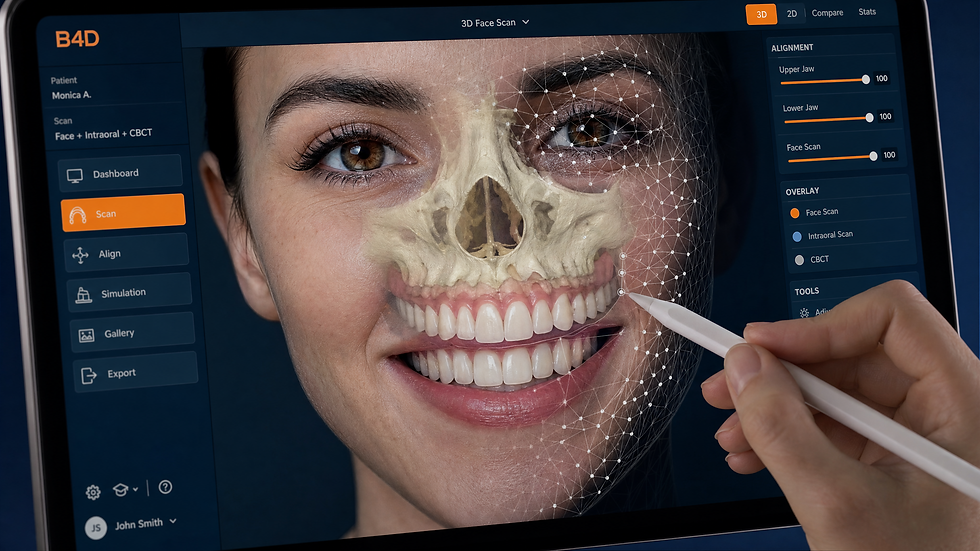
The Weight of a Triangle
The story begins with a realization: sometimes, we give the computer too much to think about.
Our instructor opened a scan that was dense — thousands upon thousands of tiny triangles (vertices) packed together. In the world of 3D math, every one of those triangles is a question the computer has to answer. When you have four, six, or ten implants to align, those questions start to pile up until the software begins to stutter.
He didn't panic. He didn't tell us to buy a faster computer. Instead, he reached for a tool to Remesh.
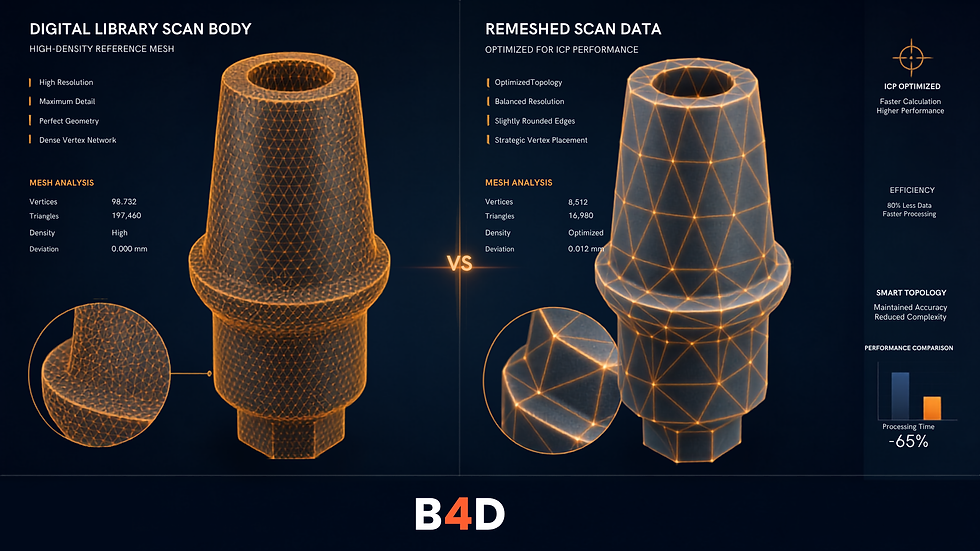
With a few keystrokes, he thinned out the density, turning a heavy mesh into a light, agile one. But here is the part that felt like a reassuring hand on a shoulder: as the sharp edges of the analog began to round off and look "blurry" on screen, he stopped to talk to the beginners in the room.
"Don't worry about the rounding of the sharp edges, we're not using them for the ICP."
It was a reminder that in digital dentistry, you need to know what matters. The sharp corner of a digital block doesn't help the alignment; the surface area does. By letting go of the unimportant details, he made the math faster without losing a single micron of accuracy.
The Mental Note
Then came the landmarks. Three points on the source, three points on the destination.
This is where the human brain and the software meet. The instructor didn't just click randomly. He placed a point on the top, one on the bottom, and one on the side — exactly 90 degrees apart. He was "locking in the directions," as he put it. Z, Y, and X.
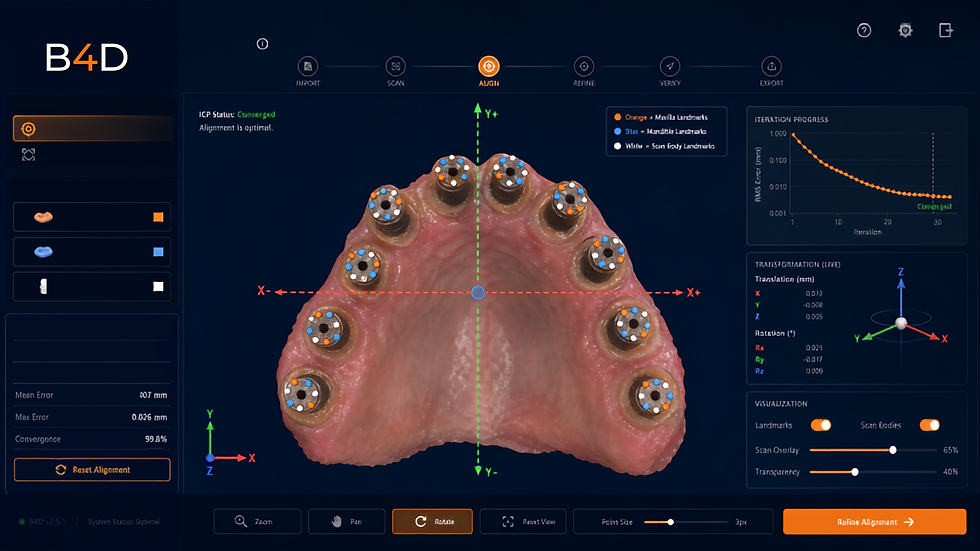
But the software isn't a mind reader. It needs the points to match. And so, he gave us the most practical, human advice of the entire session:
"Make a mental note of how you've positioned them originally."
Top, bottom, side. Top, bottom, side. It’s a rhythm. A mantra. It’s the instructor acknowledging that even in a world of high-level algorithms, success still depends on a human being paying attention and keeping a promise to be consistent.
The Magic Bit
And then, he reached for the button. The Snap.
In an instant, the single analog he had been working on duplicated itself and flew across the jaw, landing on every implant site simultaneously. It was fast. It was clean. And for a moment, the professional instructor tone broke into genuine enthusiasm:
"This is where the magic happens. I like this bit."
We all like that bit. It’s the moment where the minutes of preparation turn into a second of pure result. But the story didn't end with the magic. Because in dentistry, "close enough" is never enough.
The Quiet Search
The final act was the Refinement.
He switched the view to transparent, showing us the underlying mesh — a skeleton of vertices. He clicked "Refine," and the screen went still for a few seconds.
He filled that silence by explaining what was happening inside the machine. The software was
"looking." It was iterating through every single vertex, searching for the proximity of the underlying mesh, adjusting the fit by fractions of a hair until the two surfaces finally agreed on where they should be.
It wasn't a "fix." It was a conversation. The software was asking the scan, "Is this where you are?" and the scan was answering, "Almost... just a little to the left."
When the calculation finished, the result was a fit so precise it felt inevitable. He hid the main scan, and there they were: all the interfaces, perfectly positioned, perfectly aligned, ready for the next stage of the build.

The Lesson of the Engine Room
The ICP Alignment workflow isn't as "pretty" as a smile design. You won't see it on a patient-facing poster. But it is the reason those posters exist.
It teaches us that precision isn't about working harder; it’s about working smarter. It’s about knowing which vertices to keep and which to let go. It’s about parenting your objects so they don't get lost. And it’s about having the patience to let the software "look" for the truth in the refinement stage.
This is the heart of the B4D philosophy. We don't hide the math from you. We show you the triangles, we explain the parenting, and we give you the brushes to fix what needs fixing. Because when you understand the engine room, you never have to fear the journey.
Watch the Full Workflow
See the "magic bit" for yourself in the full technical demonstration:
About Blender for Dental
BlenderforDental (B4D) is the leading platform for human-led digital dentistry, providing clinicians and designers with complete control over their digital workflows. From diagnostic wax-ups to full-arch restorations, B4D empowers professionals to design what patients need, not what software dictates. Buy once, own for life. Learn more at blenderfordental.com.
Editor's Credit
This article was curated by Dr. Samira Alrefaey, ensuring that even our most technical workflows never lose their human heart. At BlenderforDental, we believe that understanding the 'why' is just as important as knowing the 'how'.


Comments