


How to Validate AI Dental Designs Before You Trust Them: A Human-Led Checklist for Digital


The Quiet Moment After the AI Proposal
It happens in seconds. You upload a scan, click a button, and an artificial intelligence agent returns a fully formed dental design. The morphology looks plausible. The margins appear continuous. The software tells you it is ready for production.
This is the quiet moment in modern digital dentistry. It is the space between the proposal and the reality — the pause between what the algorithm sees and what the patient needs.
For many clinicians and designers, this moment carries a specific kind of anxiety. If the software can generate the design so quickly, where does human expertise still matter? The answer is simple, but it is not trivial: the design might be finished, but trust begins after the proposal, not before it.
Automation is genuinely useful for speed, repeatability, and routine morphology. But judgment is still the skill that protects the patient, the restoration, and your professional reputation. You do not need to reject AI to maintain control. You simply need to know how to validate it.
What AI Dental CAD Does Well — And Where It Stops
To use automated tools effectively, we must be honest about their strengths. AI dental CAD excels at pattern recognition. It can process thousands of data points instantly, matching standard tooth libraries to available space. It is exceptional at batch processing and generating routine morphology for ideal preparations. For high-volume, straightforward cases, it can be a genuine efficiency multiplier.
But AI operates within a closed loop. It does not understand the biology of the patient in the chair. It does not know whether the opposing dentition has severe wear that requires a modified occlusal scheme. It cannot evaluate the health of the underlying mesh data if the intraoral scan was captured poorly.
When preparations are suboptimal, or when the clinical situation requires deviation from the mathematical average, AI proposals frequently require human intervention. A 2025 study in BMC Oral Health found that while AI and manual designs often show similar overall surface deviations, AI can produce greater maximum discrepancies and requires manual adjustment in cases with challenging preparation geometries — with suboptimal preparations triggering intervention in 6.7% of cases [1]. A 2026 systematic review similarly identifies occlusal morphology, marginal and internal fit, and mechanical performance as domains where human-led review remains essential [2].
This is precisely why "black-box" automation — where you cannot see or adjust the underlying data — is clinically dangerous. You need open architecture to perform the necessary checks. You need to see the mesh.
The B4D Human-Led Validation Checklist
Before you send any automated design to the mill or printer, it must pass a human-led review. This is not about slowing down your workflow. It is about preventing costly remakes, clinical failures, and the erosion of patient trust that comes with them.
The following framework reflects what we teach inside the BlenderforDental ecosystem. It is not a bureaucratic checklist. It is a trained eye, translated into a repeatable system.
1. Margin Line Verification
AI is generally capable of finding sharp, well-defined margins. But it struggles with subgingival preparations, areas obscured by blood or saliva during scanning, and preparations with irregular finish lines.
The Check: Zoom in on the critical zones. Does the margin follow the true finish line, or has the AI interpolated across a data gap? Look for areas where the margin spline floats above or below the preparation surface.
The B4D Advantage: In an open system, you can manually redraw or adjust the margin spline exactly where your clinical eye dictates, rather than accepting a mathematical approximation. The margin is not a parameter to be trusted blindly — it is a clinical decision.

2. Proximal Contact Intensity and Location
A crown that looks beautiful but traps food is a clinical failure. AI often calculates contacts based on simple intersection depths, without accounting for the biological and functional requirements of the interdental space.
The Check: Evaluate the broadness of the contact. Is it a point contact or a broad, stable surface? Is it positioned correctly in the occlusal-gingival and buccal-lingual dimensions to support the papilla and prevent food impaction?
The B4D Advantage: You can visualize the exact intersection depth and sculpt the contact area to create the ideal emergence profile. A global offset parameter is not the same as a designed contact.

3. Occlusal Harmony and Function
Static occlusion is straightforward for AI to calculate. Dynamic function is not.
The Check: Look beyond the static interpenetration mapping. Consider the excursive movements. Does the AI-proposed anatomy introduce premature interferences? Does it match the wear pattern of the adjacent and opposing teeth? Does the occlusal scheme respect the patient's existing neuromuscular envelope?
The B4D Advantage: You have complete control over the occlusal anatomy. You can soften cusps, deepen fossae, or adjust the curve of Spee manually to ensure the restoration functions in harmony with the patient's unique stomatognathic system — not just the average of the training dataset.
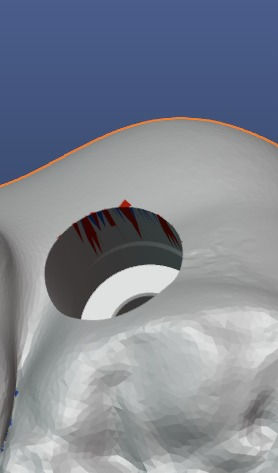
4. Mesh Integrity and Boolean Health
This is the invisible danger of closed systems. AI can generate a surface that looks solid on screen but contains non-manifold geometry, self-intersections, or inverted normals that will cause the CAM software to fail or the 3D printer to produce a structurally compromised restoration.
The Check: Inspect the underlying mesh. Are there artifacts, holes, or geometric errors that will cause downstream failure? Does the mesh close cleanly at the margin? Are there any areas of unusual triangulation density that suggest the algorithm struggled?
The B4D Advantage: BlenderforDental is built on a powerful mesh engine. You can see the wireframe, run mesh analysis tools, identify Boolean failures before they occur, and repair the data directly. This is the most fundamental form of digital control. It is also the check that closed systems make impossible.

5. Case Selection Judgment
No checklist can replace the clinical judgment that determines whether AI-assisted design is appropriate for a given case in the first place. Severely compromised preparations, complex occlusal rehabilitation, cases requiring significant emergence profile modification, and restorations in high-stress biomechanical environments all demand a higher level of human oversight from the beginning.
The Check: Before you even accept the AI proposal, ask: is this the right case for automated design? Or does the clinical complexity require manual design from the start?
The B4D Advantage: When you understand the geometry of your tools — not just the buttons — you can make this judgment reliably. Skill precedes software.

When to Accept, Adjust, or Redesign
Every AI proposal should pass through a simple three-stage clinical filter before it reaches production.
Decision | Criteria | Action |
Accept | Margin follows the finish line precisely. Contacts are broad and well-placed. Occlusion is harmonious. Mesh is clean. | Proceed to production. |
Adjust | Minor margin deviation. Contact needs repositioning. Cusp height requires softening. Mesh has minor artifacts. | Correct the specific issue and re-verify before production. |
Redesign | Margin misses the finish line. Mesh integrity failure. AI fundamentally misread the preparation geometry. Occlusal scheme is incompatible with the clinical situation. | Discard the AI proposal. Design manually from the scan data. |
The ability to make this decision quickly and confidently is not a product of better software. It is the product of trained clinical and design judgment. It is the skill that no AI can replicate, and the skill that B4D is designed to build.

How to Teach Your Eye Before You Trust Your Tools
The most advanced piece of equipment in your practice or laboratory is not your intraoral scanner, your milling unit, or your AI design software. It is your brain.
To use digital tools safely, you must train your eye to recognize failure modes before they become clinical failures. You must understand anatomy before you push buttons. You must understand geometry before you trust a mesh. You must understand occlusion before you accept a static contact map as a functional design.
This is the core philosophy of BlenderforDental. We build tools that make you think — not tools that think for you. The goal is not to make design faster at the expense of design quality. The goal is to make you faster because you are more capable.
"The goal is not to reject automation. The goal is to remain capable inside it."
When an AI proposal appears on your screen, you should be able to evaluate it the way an experienced clinician evaluates a wax-up: with a trained eye, a clear framework, and the confidence to accept, adjust, or discard.

Why Open Tools Are Not Optional
The future of digital dentistry is not a choice between human effort and artificial intelligence. It is the integration of both. But this integration only functions safely if you retain ownership of the process.
Closed, subscription-based software systems often conceal the underlying data from you. They ask for your trust without offering transparency. They trap you in a cycle of "free" updates that gradually cost you your autonomy, your skills, and your ability to intervene when the algorithm fails.
BlenderforDental operates on a different premise. We believe in true ownership — buy once, own for life. We believe in open workflows where you can see the mesh, inspect the geometry, adjust every parameter, and take full control whenever automation falls short. We continue to invest in advanced capabilities, including our own AI segmentation tools for specialized workflows such as Airways analysis, ensuring you have access to cutting-edge technology without surrendering clinical control to a black box.
The validation checklist above is only possible if your software lets you perform it. If your tools hide the mesh, obscure the margin analysis, or lock the contact parameters behind a proprietary interface, you are not validating — you are hoping.
Clinical confidence is not a feature. It is a skill. And it belongs to you.
Internal Reading Path
This article connects to a broader set of ideas that B4D has explored across our 2026 content. If this checklist raised questions about the role of human judgment in digital dentistry, continue reading:
•The Human Element: Why Your Brain is Still the Most Important Tool — The philosophical foundation for human-led digital dentistry.
•The Quiet Check Before the Cut: How iBar 2.0 Mesh Analysis Helps Prevent Boolean Failures — A deeper look at mesh inspection and Boolean failure prevention.
•Beyond STL: Leveraging Mesh Data for Superior Implant Outcomes — Why mesh literacy is the hidden skill of digital dentistry.
•Beyond the Perfect Scan: Engineering Occlusal Harmony — How to think about occlusion as a design decision, not a calculation.
•The Hidden Cost of "Free" Updates: Why True Ownership is the Future of Digital Dentistry — The economics and ethics of software ownership in a subscription world.
•The First Step: A Beginner's Guide to Digital Dentistry with B4D — If you are new to digital workflows, start here.
Ready to Build the Judgment Behind the Button?
The checklist above is a starting point. The real skill is built through practice, through understanding the geometry of your designs, and through learning to see what the algorithm cannot.
Begin with the foundational workflow for single-unit restorations. Learn to design, validate, and refine with complete control over every parameter.
From single crowns to full-arch rehabilitation, from surgical guides to mesh repair — every module is a buy-once, own-for-life investment in your clinical capability.
The goal is not to replace your judgment with software. The goal is to give your judgment the tools it deserves.
References
_________________________________________________________________________________________
About Blender for Dental
Blender for Dental (B4D ) provides open-architecture, buy-once-for-life digital dentistry software built on the philosophy that technology should serve the clinician's vision, never replace it. From single crowns to full-arch rehabilitation, from mesh repair to AI segmentation including Airways analysis, B4D empowers dentists, lab technicians, and designers with precise, control-first tools that prioritize clinical skill over black-box automation. Explore the full module library →
Connect with BlenderforDental
•Instagram: @blenderfordental
•Facebook Group: Blender for Dental Community
Editor’s Credit
This article was edited and curated by Dr. Samira Alrefaey, Blog Editor and Marketing Specialist at Blender for Dental. Through stories like this, we continue highlighting the moments where digital dentistry becomes more human: the quiet corrections, the thoughtful adjustments, and the design decisions that help clinicians turn complex geometry into confident clinical work.


Hi, I currently have Blender for Dental 4.5.5 with Crown, Components, Dentures and Gingiva modules. Could you please tell me how to activate the AI beta for crown design? Is it included in my license, or do I need a separate installation or activation key? Where can I find the AI panel inside Blender for Dental once it is activated?