


Beyond the Perfect Scan: Engineering Occlusal Harmony

Updated: Feb 15

A shift in mindset from digital sculptor to biomechanical engineer is the key to predictable, harmonious, and truly data-driven restorative dentistry.
The Sound of Compromise

The moment is familiar to every clinician and technician who has embraced digital fabrication. The restoration, milled or printed, drops perfectly onto the die or the prepared tooth. The marginal fit is impeccable, the interproximal contacts are snug, and the esthetics are precisely what the design promised. Yet, when the patient closes, the sound is not the quiet click of success, but the grating sound of compromise. The chairside adjustment begins—a frustrating, time-consuming process of grinding away the digital promise, chasing an elusive occlusal harmony that should have been engineered, not discovered.
This moment of friction is the silent admission that the digital workflow, for all its precision, has failed to capture the most critical element of restorative dentistry: function. We have mastered the geometry of the static tooth, but we have neglected the choreography of the dynamic jaw.
The Core Problem: The Illusion of Complete Data

The anxiety and inefficiency of post-delivery occlusal adjustment stem from a fundamental flaw in the mindset of many transitioning digital professionals: the belief that the intraoral scan provides complete data.
The STL or PLY file generated by the scanner is a magnificent capture of surface geometry—a perfect, high-resolution snapshot of the teeth at a single, static point in time. But occlusion is not a static event; it is a complex, three-dimensional, time-dependent interaction. Relying solely on the static scan is like judging a symphony by a single, frozen frame of the conductor.
The core problem is Design Complacency. We become so impressed by the accuracy of the scan and the fit of the restoration that we overlook the need to synthesize functional data—the patient's unique envelope of motion, their incisal guidance, their lateral excursions, and the precise location of their hinge axis. Without this dynamic data, the CAD software is forced to rely on generic, average values, resulting in a restoration that is geometrically perfect but biomechanically inert.
This reliance on incomplete data creates a gap between the captured form and the required function. The digital blueprint is only half-drawn, and the clinician is left to complete the engineering with a bur, introducing heat, stress, and unpredictability into a system designed for precision.
Design-First Insight: The Functional Path as the Primary Constraint
The confident digital professional understands that the scan is merely the substrate upon which the true blueprint is drawn. The goal is not to design a crown that fits the preparation, but a restoration that guides the function.
This design-first insight reframes the entire process: the functional path is the primary constraint, and the static geometry must conform to it.
In the BlenderforDental environment, this means moving beyond simple model alignment and engaging with the tools that simulate the patient's unique jaw mechanics. The virtual articulator is not a novelty; it is the essential validation tool that separates the digital sculptor from the biomechanical engineer. It allows the designer to visualize and manage the occlusal envelope—the three-dimensional space swept by the opposing arch during all functional movements.
The blueprint for occlusal harmony is therefore a synthesis of three data layers:
1.Static Geometry: The high-resolution STL/PLY data from the intraoral scan.
2.Skeletal Relationship: The CBCT data and the precise location of the hinge axis.
3.Dynamic Function: The virtual articulation data, capturing the patient's unique guidance and excursive movements.
Only when these three layers are fused and validated can the design truly be considered a data-driven blueprint.
Clinical Application: Engineering the Load
Prosthetic Design and Virtual Articulation

In advanced prosthetic design, the focus shifts from simply establishing maximum
intercuspation (MI) to engineering the disclusion. The lingual contour of an anterior restoration, for example, is not an esthetic choice; it is a biomechanical lever that dictates how quickly and smoothly the posterior teeth disclude during lateral and protrusive movements.
Using the virtual articulator, the designer can precisely map the functional path and design the restoration to ensure:
•Immediate Disclusion: Posterior teeth separate instantly upon movement.
•Smooth Guidance: The guidance path is free of interferences.
•Load Management: Forces are distributed along the long axis of the tooth or implant.
This proactive design eliminates the guesswork and the destructive chairside search for harmony.
Implant Planning and Load Axis Management

For implant-supported restorations, occlusal harmony is a matter of long-term survival. The occlusal scheme dictates the load axis, and the design must ensure that the force vector passes as close as possible to the center of the implant platform.
In the planning phase, the virtual tooth setup (the occlusal design) is used to reverse-engineer the ideal implant position. If the occlusal requirements (e.g., a shallow cusp-to-fossa relationship for a bruxer) conflict with the bone volume, the confident planner uses the data to inform a compromise—either a different restorative material, a change in implant size, or a discussion with the patient about the biomechanical limitations. The occlusal blueprint dictates the surgery, not the other way around.
CAD/CAM and Compensation
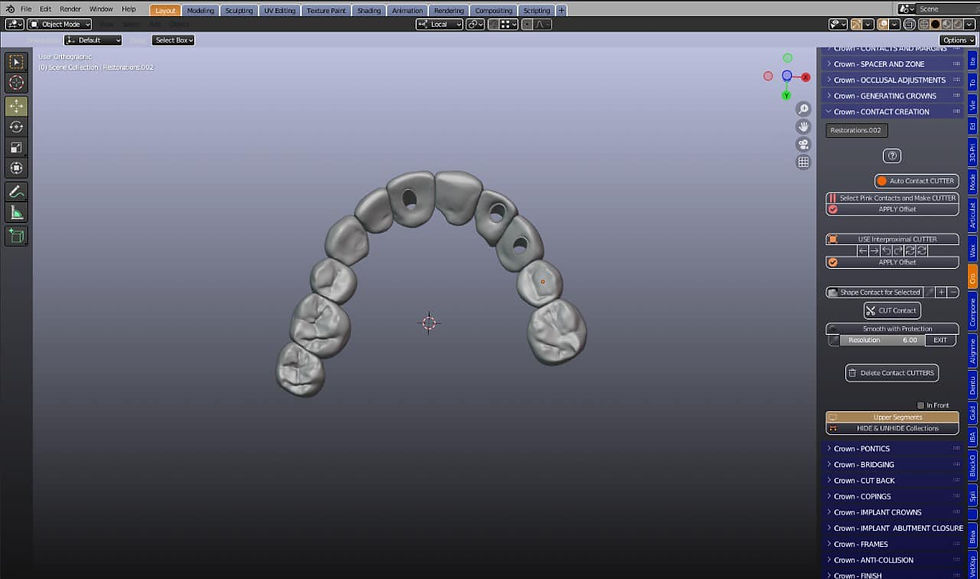
The final stage of the blueprint involves ensuring the CAD/CAM process honors the design. This requires understanding the limitations of the manufacturing process. For instance, the milling bur cannot create a perfectly sharp cusp tip or a perfectly deep fossa. The design must be compensated in the CAD software to account for the bur radius, ensuring that the manufactured restoration retains the functional contacts and clearances defined in the virtual articulator. This is the difference between a design that looks good on screen and one that functions perfectly in the mouth.
The Shift in Perspective: From Sculptor to Engineer

The mental shift that separates the confident digital professional from the frustrated one is the transition from Digital Sculptor to Biomechanical Engineer.
The Digital Sculptor is focused on the visual—the perfect margin, the beautiful contour, the smooth surface. They are reactive, relying on the visual fidelity of the scan and hoping the function will follow.
The Biomechanical Engineer is focused on the system—the forces, the vectors, the movements, and the materials. They are proactive, using data synthesis to predict and eliminate functional interferences before the first line of code is executed for milling. They move from asking, "Does this look right?" to the more authoritative question: "Is this design optimized for the long-term functional health of the entire stomatognathic system?"
This shift is the key to unlocking true digital mastery. It is the realization that the power of the digital workflow is not in the capture of geometry, but in the synthesis of function.
Occlusal Harmony

The blueprint for occlusal harmony is not found in the scan file; it is built through the intelligent integration of static and dynamic data. Mastery in digital dentistry is not about avoiding the bur entirely, but about reducing the chairside adjustment to a final, minor polish—a confirmation of the design, not a correction of a fundamental flaw.
Embrace the role of the Biomechanical Engineer. Demand more from your data. Design the functional path first, and the static form will follow. This is the path to predictable, harmonious, and truly data-driven restorative dentistry.
This methodology represents the core philosophy of BlenderforDental (B4D)—a thinking tool, not just software. B4D empowers clinicians and technicians to take control of the entire digital workflow, from data synthesis to biomechanical validation, without costly subscriptions or black-box automation. It's about building capability, not dependency.
Ready to engineer your next restoration with confidence?
→ Explore the B4D Virtual Articulator and Data-Driven Workflows
We believe that true mastery comes from understanding the process, not just trusting an algorithm. By integrating static geometry, skeletal relationships, and dynamic function, you move from being a scan operator to a true biomechanical designer.
Take control of your digital workflow and build lasting skills.

Ready to engineer your next restoration with confidence? Explore the B4D virtual articulator and discover how data-driven design transforms outcomes


Fantastic article! Biomechanical engineering principles lead to functional & occlusal harmony.
Begin with the end in mind 👍🏼