


The Deliberate Pause: Stress Breakers, Attachments, and the Art of Controlled Dental Design

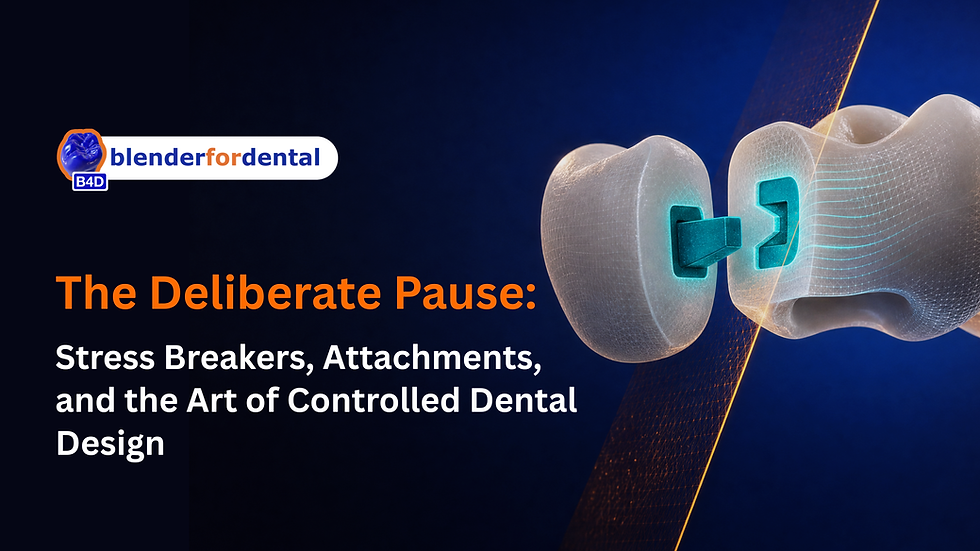
In prosthodontics, we often admire the visible finish first. We look at the anatomy of the crown, the smoothness of the pontic, the shine of the framework, the elegance of a full-arch design. Yet the success of a restoration is often decided in a quieter place: at the interface where one part of the prosthesis meets another, where a tooth meets a denture, where a bridge crosses a pier abutment, or where two insertion paths refuse to become one.
That is where the idea of the stress breaker begins.
For years, the term has carried a kind of mystery. It sounds like a hidden device, a secret component, something added to absorb force. But its deeper meaning is more refined. A stress breaker is not simply a part. It is a design decision. It is the moment when the clinician or designer recognizes that rigidity, although powerful, is not always protective.
A rigid prosthesis can be beautiful and still be unforgiving. A long-span bridge can look continuous and still behave like a lever. A removable partial denture can seat comfortably at rest and still torque the abutment when the distal saddle sinks under function. A multi-unit restoration can be designed as one body and still demand separate paths of insertion.
The stress breaker enters at this point of tension. It does not weaken the design. It teaches the design how to respect movement.
The Silent Language of Unequal Movement
Every prosthesis lives in a field of forces. Occlusal pressure travels through crowns, retainers, connectors, implants, roots, periodontal ligaments, mucosa, bone, and framework geometry. The problem is not that force exists. The problem begins when different biological and mechanical supports are forced to respond as if they were the same.
A tooth is not mucosa. A pier abutment is not a passive midpoint. A distal-extension saddle does not behave like a tooth-supported span. A bridge with nonparallel abutments does not always accept a single path of insertion. When a design ignores these differences, stress becomes concentrated, and the most vulnerable area begins to pay the price.
In removable partial denture biomechanics, this is especially clear. The abutment tooth is supported by the periodontal ligament, while the distal-extension denture base rests on compressible mucosa. Under function, the tissue-supported saddle can move more than the tooth-supported retainer. If the two are tied together too rigidly, the denture base can act as a lever and transfer harmful torque to the abutment tooth.1,2
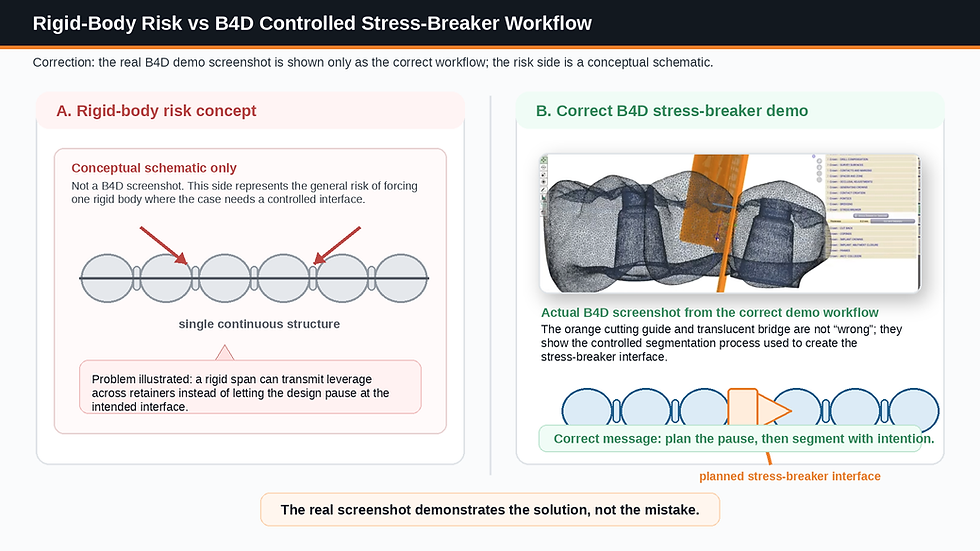
In fixed partial dentures, the story changes but the principle remains. In a long-span bridge with a pier abutment, the intermediate abutment can behave like a fulcrum. When the span is completely rigid, occlusal loading on one side may create tensile or dislodging forces on another retainer, increasing the risk of debonding, marginal leakage, caries, or prosthetic failure.3,4
Clinical Situation | Hidden Mechanical Problem | Stress-Breaker Logic |
Distal-extension removable partial denture | The mucosa-supported saddle moves more than the tooth-supported retainer. | A resilient attachment, hinge, flexible clasp, or split connector reduces torque on the abutment. |
Long-span fixed bridge with pier abutment | The pier abutment may act as a fulcrum inside a rigid bridge. | A non-rigid key/keyway connector interrupts harmful leverage between segments. |
Bridge with nonparallel abutments | One rigid structure may not seat along multiple insertion paths. | A segmented connector allows each section to seat according to its own path. |
Implant or hybrid bridge with divergent connections | The restoration may need staged seating because screw channels and implant axes differ. | A controlled split and interlocking interface can make delivery possible while preserving strength. |
This is the silent language of stress. It is not always visible on the screen. It does not always announce itself during design. But it waits inside the geometry, inside the connector, inside the way one component asks another component to move.


Where the Design Learns to Pause
A stress breaker is best understood as a controlled interruption of rigidity.
In a fixed bridge, this may appear as a non-rigid connector: a male-and-female key/keyway, tenon-and-mortise, or matrix-and-patrix design placed between a retainer and pontic segment. In many pier-abutment designs, the female keyway is commonly positioned in the distal aspect of the pier retainer, while the male key is associated with the adjacent pontic segment. The goal is not uncontrolled looseness. The goal is a precise mechanical relationship that allows limited independent behavior while preventing the bridge from acting as one destructive lever.3,4
In a removable partial denture, the stress breaker may take another form. It may be a resilient extracoronal attachment, a hinge, a ball-and-socket element, a split bar, a divided connector, or a clasp assembly designed to release rather than torque the abutment as the denture base moves tissue-ward under load.1,2
In a digital bridge workflow, the same principle can also appear as segmentation. When abutments or implants do not share the same path of insertion, forcing the case into a single body can create a design that looks complete but cannot seat predictably. A controlled split, interlocking connector, and planned assembly sequence can transform a difficult case from a struggle into a deliberate workflow.
A stress breaker is not the absence of strength. It is strength placed with intelligence.

This is where the language of prosthodontics becomes almost architectural. The designer is no longer asking, “How do I make this one solid object?” The better question becomes, “Where should this restoration remain rigid, and where should it be allowed to pause?”
From Prosthodontic Principle to B4D Workflow
This is where BlenderforDental becomes more than a software environment. It becomes a place where the hidden logic of the restoration can be made visible.
In a closed or highly automated workflow, the connector may feel like something buried inside the software. The user selects an option, accepts a default, and hopes the geometry understands the case. But stress breakers demand more than hope. They demand inspection, alignment, clearance, thickness control, and respect for insertion paths.
B4D’s philosophy is different. It is built around human-led digital dentistry, where the designer remains close enough to the geometry to understand what is happening and skilled enough to change it when the case requires it.5 In B4D workflows, the user can see the bridge, see the screw channels, inspect the internal relationships, align parts in space, create cuts, evaluate thickness, and decide where the connector should live.
The dedicated B4D stress-breaker workflow demonstrates this principle clearly. The bridge is not treated as an untouchable single mass. It is split into interlocking segments, with attention to the male/female connector, the path of insertion, the underlying implant connection, the screw channel, the interproximal cut location, and the wall thickness around the attachment.

The B4D demo matters because it shows a designer refusing to treat the bridge as one stubborn object. First, the internal anatomy is allowed to become visible. Transparent and wireframe views turn the implant connection from an invisible risk into a visible part of the decision. The cut is not placed because the tool can cut; it is placed because the geometry has been listened to.
Then the path of insertion begins to govern the story. The stress breaker is guided away from the implant connection, and the bridge is oriented so the future segments can follow a believable mechanical path. This is where the workflow stops feeling like software operation and starts feeling like prosthetic judgment.
The cut itself is quiet. It moves through the contact area rather than asking the visible porcelain to carry the burden of the split. Around it, the designer watches thickness, tissue level, and local clearance, not as separate checklist items, but as the conditions that decide whether the final connector will feel deliberate or fragile. At the end, the crowns are hidden and the lock is inspected. Only then does the design earn trust.
That matters because a stress breaker is only protective when it is placed with intention. If it intersects a screw channel, weakens a wall, compromises the aesthetic surface, or ignores the path of insertion, it stops being a protective feature and becomes a new problem. The beauty of the B4D approach is that these risks can be seen before they are manufactured.
B4D Design Concern | Why It Matters for Stress Breakers | Practical Meaning |
Transparent or wireframe visualization | The connector must respect internal anatomy and screw channels. | The designer can inspect hidden structures before cutting or splitting. |
Controlled bridge splitting | A long-span or divergent case may need more than one seating path. | The prosthesis can be divided into segments that assemble predictably. |
Connector alignment | A key/keyway or interlocking interface must follow the intended insertion path. | The stress breaker becomes a functional mechanical union, not a random joint. |
Thickness verification | The area around the attachment must remain strong enough for manufacture and function. | The designer protects both mechanics and material integrity. |
Boolean and cutter control | Stress-breaker geometry often depends on clean cuts and reliable mesh behavior. | The user can prepare geometry before committing to the operation. |
B4D does not remove the responsibility of design. It reveals it.

Attachments, iBars, and the Geometry of Trust
The broader B4D ecosystem makes this conversation even more relevant because stress-breaker thinking is not limited to one button or one module. It belongs to a larger discipline: the discipline of controlled interfaces.
In iBar workflows, B4D supports reverse-engineering a bar inside a completed hybrid prosthesis, with control over thickness, cement space, screw chamber preservation, screw chamber re-engineering, and split or individual bar strategies.
Even when the goal is not a classical prosthodontic stress breaker, the design mindset is similar. The user is shaping how components relate to each other, how space is preserved, how forces travel, and how the restoration will be assembled.
In EasyEdge workflows, B4D supports milled rests and seats, parallel milled slots, imported bridge work, orientation positions for existing precision attachments, beveling around milled rest seats, and safeguards for minimum thickness. This connects naturally to stress-breaker thinking because path of insertion is not an abstract concept. It is geometry. It is the shape of the seat, the direction of the slot, the clearance of the interface, and the trust that one part can meet another without resistance.
In Denture Designer and partial denture workflows, the relationship becomes more biological. A removable prosthesis must respect tissue movement, tooth support, undercuts, block-out decisions, framework design, and patient comfort. B4D’s denture-related content describes workflows for full and partial denture cases, tooth setup adjustment, gum shaping, safety zones, and hybrid appliance design.
Together, these tools support a deeper idea: dental CAD should not hide the interface. It should let the clinician and designer study it.
The connector is not a small detail at the edge of the case. It is often the place where the whole case tells the truth.
Beyond Mechanics: Protecting Biology
It is tempting to speak about stress breakers only in mechanical language: force distribution, fulcrums, torque, rotation, vertical displacement, tensile stress, and paths of insertion. All of that language matters. But the reason it matters is biological.
A removable partial denture stress breaker is not designed to celebrate movement. It is designed to protect the abutment tooth from movement it should not be forced to carry. A non-rigid connector in a long-span bridge is not designed to make the bridge interesting. It is designed to reduce harmful leverage on retainers and abutments. A segmented bridge for divergent implants is not designed to complicate the case. It is designed to make seating possible without forcing the restoration or the patient’s biology into a compromise.
This is the kind of thinking B4D encourages. The software becomes a quiet space where the designer can slow down, rotate the model, reveal what is hidden, and ask better questions. Is this connector aligned with the actual path of insertion? Is there enough material around the attachment? Is the cut placed thro
ugh a safe interproximal zone rather than through the facial anatomy? Is the screw access protected? Is the patient’s biology being asked to tolerate a design problem that could have been solved digitally?
B4D’s wider investment in intelligent visualization, including segmentation developments such as Airways, reflects the same philosophy: complex anatomy and complex geometry should be made clearer, not concealed.9 The point is not that automation replaces judgment. The point is that better visibility supports better judgment.
The Confidence of Human-Led Design
There is a special confidence that comes from understanding why a design will work.
It is different from the confidence of pressing a button. It is quieter and stronger. It comes from knowing that the connector was placed deliberately, that the path of insertion was respected, that the thickness was checked, that the bridge was split because the case asked for it, and that the attachment is serving the prosthesis rather than decorating it.
This is why stress breakers belong naturally inside the B4D conversation. They are not only about mechanics. They are about ownership of the design decision.
With BlenderforDental, the clinician or designer is not locked into a workflow that says, “accept what the software gives you.” The B4D philosophy is to give users control over crowns, bridges, dentures, iBars, guides, splints, and complex digital workflows while preserving the freedom to learn, inspect, modify, and master the geometry.
That is the deeper promise of human-led digital dentistry. It does not simplify every case into a shortcut. It gives the designer the tools to face complexity with clarity.
A stress breaker is one of those moments where clarity matters.

It is the deliberate pause in the design. The controlled interruption. The place where rigidity becomes wisdom. The hidden interface that protects the visible result.
And when it is designed with intention, it reminds us of something important: lasting dentistry is not built only by making restorations strong. It is built by knowing exactly where they should be allowed to move.
Ready to Design Restorations with More Control?
If you want to explore workflows that let you see, split, align, and refine complex dental geometry, visit the B4D Shop and explore the modules that fit your clinical work.
To see the stress-breaker concept in action, watch the BlenderforDental tutorial “No Stress with Stress Breakers – Here’s How!”. You can also explore B4D’s bridge-splitting and EasyEdge workflows through the official Blender for Dental YouTube channel.
Design the pause. Protect the system. Own the workflow.
-------------------------------------------------------------------------------------------------------------
Connect with BlenderforDental
•Instagram: @blenderfordental
•Facebook Group: Blender for Dental Community
Editor's Credit
This article was edited and curated by Dr. Samira Alrefaey, Blog Editor & Marketing Specialist at BlenderforDental. We are dedicated to providing insights and resources that empower dental professionals to achieve unparalleled surgical confidence and deliver exceptional patient care.
About BlenderforDental
BlenderforDental (B4D) is the leading platform for human-led digital dentistry, providing clinicians and designers with complete control over their digital workflows. From full-arch restorations to surgical guides, B4D empowers professionals to design what patients need, not what software dictates. Buy once, own for life. Learn more at blenderfordental.com.


Comments